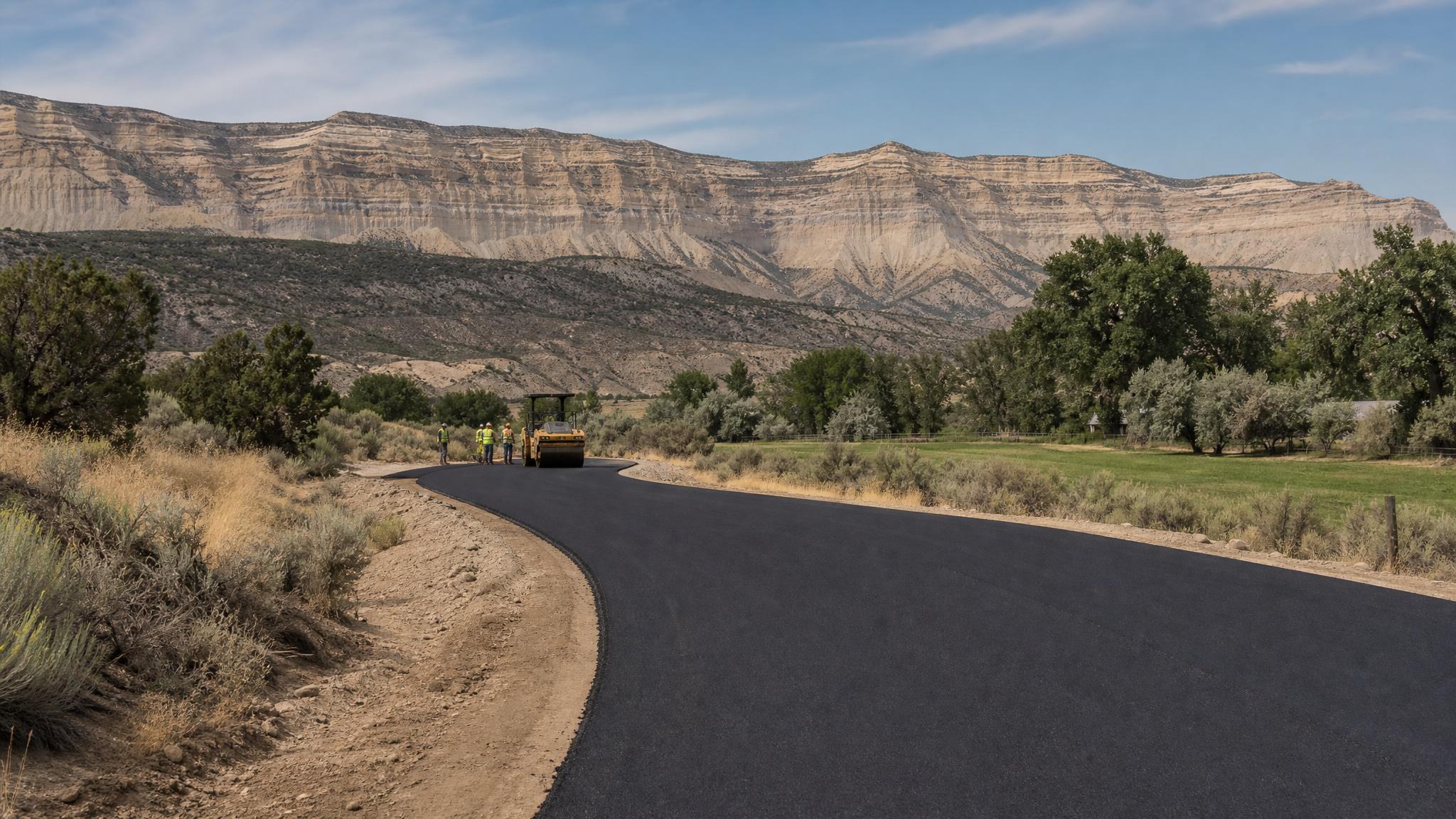
Private roads and long driveways
Longer asphalt projects need attention to base, drainage, slope, width, expected vehicle load, and access for trucks/rollers.
Common projects
- Ranch or acreage access roads
- Private lanes
- Long residential driveways
- Shop or outbuilding access
- Gravel-to-asphalt conversion
- HOA or shared private roads
Why long private roads wear differently than a driveway
A private road that runs several hundred feet or more behaves more like a rural county road than a residential driveway. Grade changes, drainage swales, culverts, and varying soil along the route all affect how the base performs, and a section that holds water after irrigation season or spring runoff can fail years before the rest of the road shows any wear. Western Colorado's freeze-thaw cycles make that gap worse: water trapped under a low spot expands as it freezes, then leaves a void as it thaws, and repeated cycles through the winter can turn a soft spot into a pothole or a section of alligator cracking well before the rest of the pavement needs attention.
Chip seal vs. asphalt paving for long access roads
Ranch roads, HOA lanes, and long acreage driveways are one of the few places on the Western Slope where a chip seal is worth weighing against full asphalt paving. Chip seal, which embeds stone chips into a sprayed binder rather than laying a hot-mix asphalt surface, generally costs less per foot to install and can hold up reasonably well on lower-traffic rural roads, but it produces a rougher ride, sheds loose stone for a period after installation, and typically needs more frequent resealing than asphalt. Full asphalt paving costs more upfront but gives a smoother surface, holds up better to daily vehicle traffic, and is usually the better fit for roads that see regular passenger-vehicle use, deliveries, or shared HOA access rather than occasional equipment or livestock trailer traffic. The right call often depends on traffic volume, budget cycle, and how the road owner weighs upfront cost against a smoother, longer-lasting surface.
Drainage and culverts along private roads
Water is usually the biggest long-term threat to a private road's asphalt, more so than traffic. Roadside ditches, culvert crossings, and the crown or cross-slope of the paved surface all need to move water off the road rather than letting it pond at low points or saturate the base from the shoulder inward. Before paving or repaving a private road, it helps to note where water currently collects, whether existing culverts are undersized or blocked, and whether irrigation ditches or seasonal runoff cross the route, since correcting drainage at the same time as paving is usually more cost-effective than repairing drainage-related failures later.
Estimate details to include
Approximate length and width, current surface, drainage concerns, steep grades, culverts, vehicle loads, and photos.
HOA and shared-road budgeting notes
Private roads owned or maintained by an HOA add a budgeting layer on top of the paving decision itself. Boards typically need a scope that separates urgent safety repairs from planned resurfacing, a bid that spells out base work versus surface work, and a phasing plan if the road cannot be fully closed during construction. The HOA and private road asphalt budget checklist walks through the questions a board should answer before requesting bids.
Asphalt services in Grand Junction, the Grand Valley, and nearby Western Slope communities
- Asphalt Paving Grand Junction CO
- Driveway Paving Grand Junction CO
- Parking Lot Paving Grand Junction CO
- Asphalt Repair Grand Junction CO
- Pothole Repair Grand Junction CO
- Sealcoating Grand Junction CO
- Crack Sealing Grand Junction CO
- Asphalt Resurfacing Grand Junction CO
- Parking Lot Maintenance Grand Junction CO
- Parking Lot Striping Grand Junction CO
- Private Road Paving Grand Junction CO
- Asphalt Paving Cost Grand Junction CO
- Grand Junction Service Area
- Fruita Asphalt Paving
- Clifton Asphalt Paving
- Palisade Asphalt Paving
- Western Slope Asphalt Paving
- Contact / Estimate